Learn
A new grazing paradigm.
Watching and moving livestock from your phone, with no fence to build, changes ranching. It is harder to do well than it looks, and easier to mess up than polywire. As with most things, the profit is in the details.
We help you skip the mistakes we made starting out, whether you are learning the new system or unlearning the old one.
Start here
How virtual fencing works
No wire. You draw the fence on a map in the app.
- Step one Research Match hardware and software to your place. We help, and so do some of our partners. Will it pay? →
- Step two Collar Every mature animal wears one. The young follow their mothers.
- Step three Draw Mark where livestock can graze on a map of your place. No posts, no wire.
- Step four Warn An animal heading for the line hears a sound first.
- Step five Contain Keep going and she gets a pulse or a muscle contraction, turning her back.
- Step six Learn/Adapt They learn the cue and stop pushing the boundary.
Control where livestock graze without building fence. Some states still require a boundary fence. We can tell you if yours does.
The trade-offs
What you get
From every collar
- Cross fence without building any. Including country too rough or too big to fence.
- Contain and monitor livestock on your phone. Every collared animal, all day.
- More rest, or more grazing intensity. Or both, paddock by paddock.
- Keep livestock off ground you want rested. Creeks, burns, a neighbor's fence line.
From some collars
- A cue that moves your livestock. Two of the six do it.
- Behavior data. Two of the six report heat and rumination.
What it takes
- A payment. You are on the hook for the collars, up front or every year. Stop paying and the fence stops.
- Hardware that wears out. No hardware is perfect. How long it lasts, and what happens when it fails, differs by company.
- Discipline about laying eyes on them. Moving stock no longer requires seeing them. Used wrong, that is hard on the land, the livestock, and the business.
- Gathering to collar up. Every mature animal comes through for one, and again when new animals join the herd.
- Days before it holds. Three to ten days for the herd to learn the cue, depending on the system. Every new animal learns it again.
Does it pay on your place?
Three things to weigh.
CapEx, our infrastructure development app
Collars move the animals. Water decides how well you graze. A ranch with good fence and short water can’t use all its grass.
Draw water, tanks, pipe and fence on your ground. See the grazing acres and the return on each. Complimentary for virtual fence users.
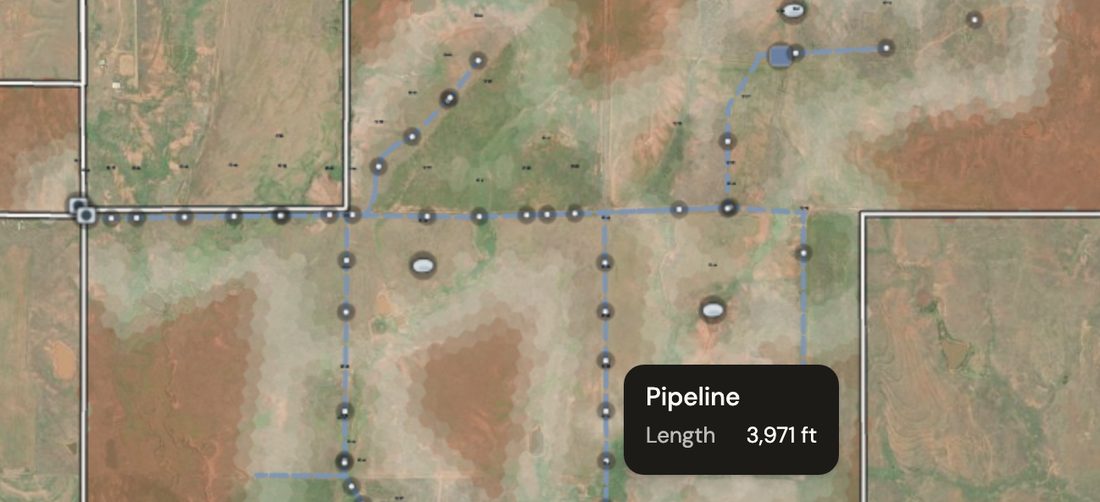
Water points and routed pipe, priced as you draw them.
Two ways to find out
Is this right for me?
What collars would cost on your place, and what they could be worth.
Will it pay? → All six companiesResearch my options
Every company selling collars in the US, side by side. What they cost and how the contracts work.
Compare the companies →Where to go from here